
Perspektif Mahasiswa Fisika Kelas Kimia Umum terhadap Rehidrasi melalui Minuman Elektrolit Alami dalam Program MBG
Article Sidebar
Main Article Content
Abstract
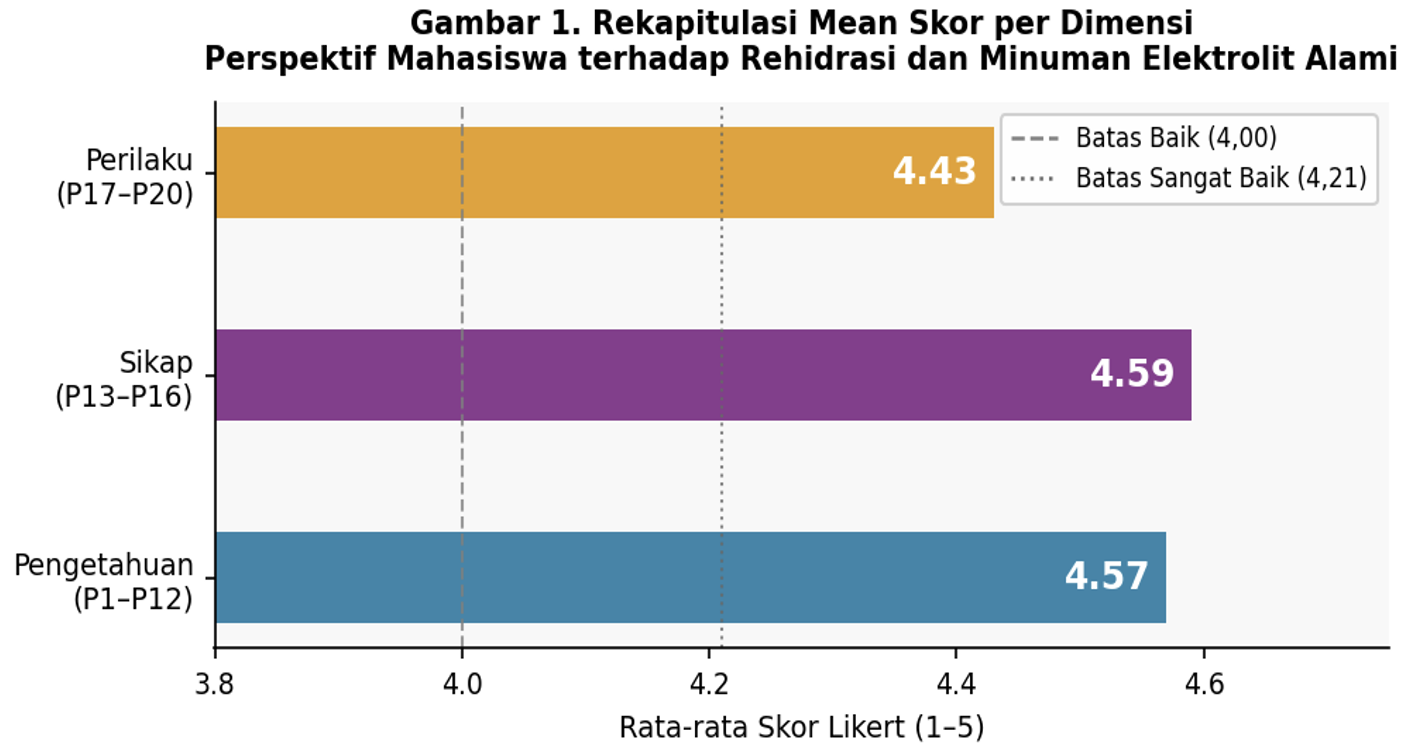
While national nutritional programs are increasingly promoted, university students' awareness of science-based rehydration remains largely overlooked. This paper explores how General Chemistry students at the State University of Medan (UNIMED) perceive rehydration and bodily ion balance. Crucially, it examines these concepts through the lens of natural electrolyte beverages meant to supplement the national Free Nutritious Food Program (MBG). To achieve this, we gathered data from 41 active chemistry students using a quantitative descriptive design via voluntary convenience sampling. The research instrument consisted of a 5-point Likert questionnaire (20 items) covering knowledge, attitude, and behavior dimensions, demonstrating sound validity (r-calculated: 0.700–0.954) and exceptional reliability (α = 0.983). Our descriptive metrics highlight strong baselines across knowledge (mean: 4.57) and attitude (mean: 4.59), with behavior trailing slightly at 4.43—all settling comfortably within the good-to-excellent bracket. Even so, the data uncovers a clear knowledge-behavior gap: roughly 31.7% of surveyed students still bypass natural electrolyte drinks after working out. Ultimately, this proves that a solid conceptual grasp and positive outlook on ion balance do not automatically spark consistent, real-world healthy habits. This study recommends integrating contextual learning and practical sessions on making natural electrolyte drinks into General Chemistry courses as an effort to support health literacy and strengthen nutrition education in the MBG Program.
Downloads
Article Details

This work is licensed under a Creative Commons Attribution 4.0 International License.
You are free to:
- Share — copy and redistribute the material in any medium or format
- Adapt — remix, transform, and build upon the material
- for any purpose, even commercially.
- The licensor cannot revoke these freedoms as long as you follow the license terms.
Under the following terms:
-
Attribution — You must give appropriate credit, provide a link to the license, and indicate if changes were made. You may do so in any reasonable manner, but not in any way that suggests the licensor endorses you or your use.
- No additional restrictions — You may not apply legal terms or technological measures that legally restrict others from doing anything the license permits.
Notices:
- You do not have to comply with the license for elements of the material in the public domain or where your use is permitted by an applicable exception or limitation.
- No warranties are given. The license may not give you all of the permissions necessary for your intended use. For example, other rights such as publicity, privacy, or moral rights may limit how you use the material.