
The Analysis of Vitamin C Content in Facial Serum Using UV–Vis Spectrophotometric Method
Article Sidebar
Main Article Content
Abstract
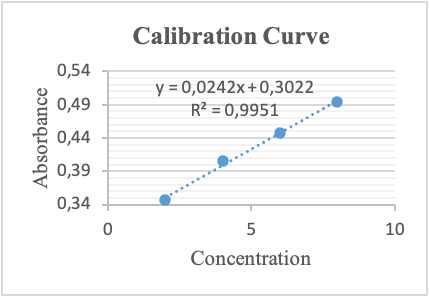
Facial serum is a category of skin care products designed to deliver concentrated active ingredients that promote the penetration of bioactive compounds into deeper layers of the skin, targeting various skin problems such as aging, hyperpigmentation, and acne. According to the literature, stable formulations of vitamin C at the right concentration can significantly reduce signs of aging and improve skin radiance. This study aims to determine the concentration of vitamin C contained in commercially available facial serums claimed to contain vitamin C, using the UV-Visible spectrophotometry method. Three samples were analyzed, namely; Serum 1, Serum 2, and Serum 3. A calibration curve was obtained using standard series concentrations of 2 ppm, 4 ppm, 6 ppm, and 8 ppm at an optimum wavelength of 241.50 nm, resulting in a regression equation of y = 0.0242x + 0.3022 with a correlation coefficient of r = 0.9975 and a determination coefficient of R² = 0.9950. The limit of detection (LOD) was 0.54 ppm and the limit of quantification (LOQ) was 1.81 ppm. The results of this study indicate that all tested samples contained vitamin C, with concentrations in Serum 1 = 338 mg/L, Serum 2 = 267.7 mg/L, and Serum 3 = 284.2 mg/L
Downloads
Article Details

This work is licensed under a Creative Commons Attribution 4.0 International License.
Copyright and Licensing
For all articles published in Fullerene Journal of Chemistry, Authors retain some copyright and grant the journal right of first publication with the work simultaneously licensed under a Creative Commons Attribution 4.0 International (CC BY 4.0) that allows others to share the work with an acknowledgment of the work's authorship and initial publication in this journal. Authors are able to enter into separate, additional contractual arrangements for the non-exclusive distribution of the journal's published version of the work (e.g., post it to an institutional repository or publish it in a book), with an acknowledgment of its initial publication in this journal. Authors are permitted and encouraged to post their work online (e.g., in institutional repositories or on their website) prior to and during the submission process, as it can lead to productive exchanges, as well as earlier and greater citation of published work. In addition, the article may be reused and quoted provided that the original published version is cited. These conditions allow for maximum use and exposure of the work while ensuring the authors receive proper credit.
Authors are free to:
- Share - copy and redistribute the material in any medium or format
- Adapt - remix, transform, and build upon the material for any purpose, even commercially.
Under the following terms:
- Attribution - You must give appropriate credit, provide a link to the license, and indicate if changes were made. You may do so in any reasonable manner, but not in any way that suggests the licensor endorses you or your use.
- No additional restrictions - You may not apply legal terms or technological measures that legally restrict others from doing anything the license permits.
Notices: You do not have to comply with the license for elements of the material in the public domain or where your use is permitted by an applicable exception or limitation. No warranties are given. The license may not give you all of the permissions necessary for your intended use. For example, other rights such as publicity, privacy, or moral rights may limit how you use the material.