
Optimization of Activated Carbon Conditions for the Adsorption of Methylene Blue Dye
Article Sidebar
Main Article Content
Abstract
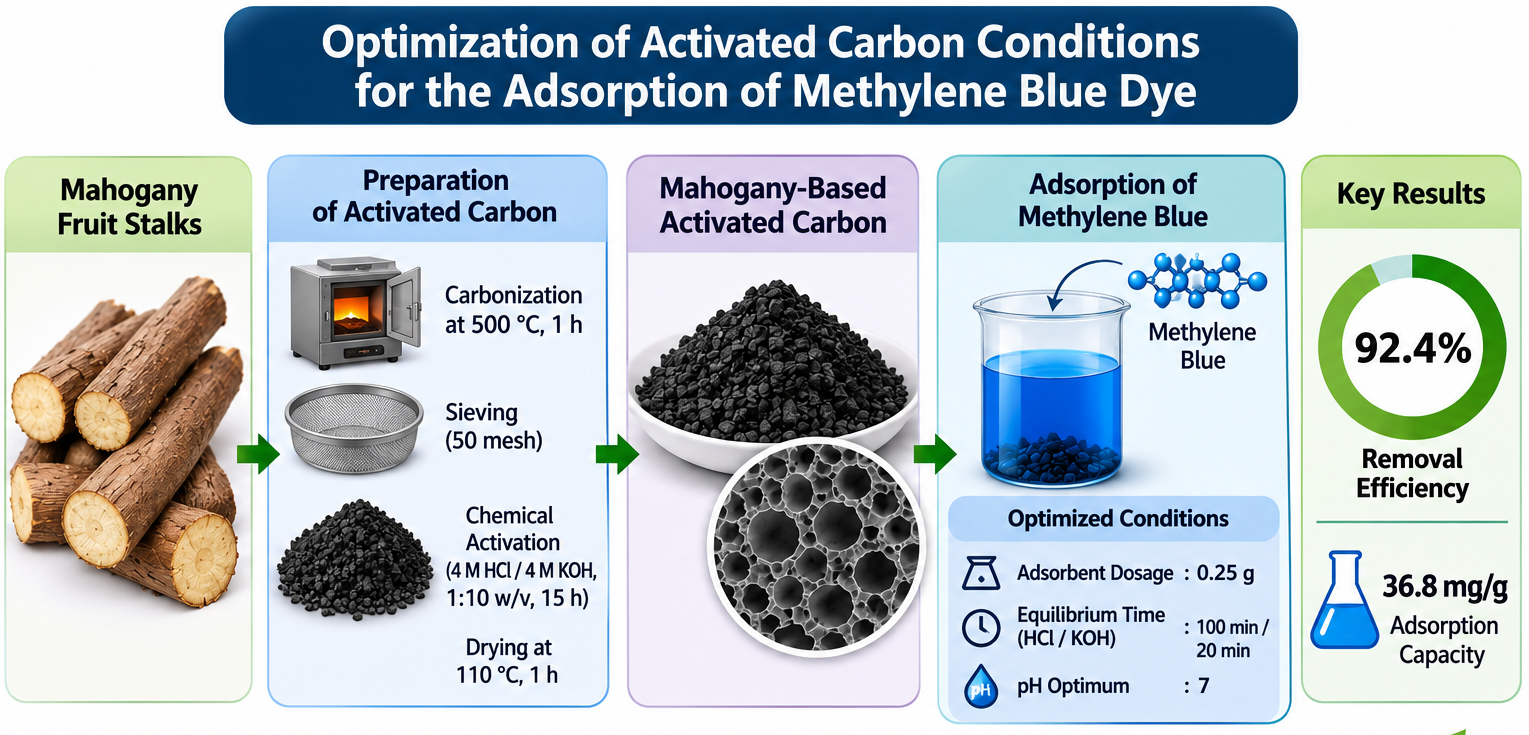
The adsorption of synthetic dyes remains a significant environmental challenge, and methylene blue is frequently used as a model pollutant in adsorption studies. However, the adsorption capacity of activated carbon derived from mahogany fruit pulp has not been previously reported. This study aimed to investigate the optimum conditions of mahogany-based activated carbon for methylene blue removal. Activated carbon was prepared through carbonization of mahogany fruit stalks at 500 °C for 1 h, followed by cooling and sieving through a 50-mesh screen. The material was then chemically activated by immersion in 4 M HCl and 4 M KOH solutions for 15 h, followed by drying at 110 °C for 1 h. Adsorption experiments were carried out using UV–Vis spectroscopy to evaluate dye removal efficiency under acidic and basic conditions. The results indicated that the optimum dosage of activated carbon was 0.25 g, with equilibrium reached at 100 min under acidic conditions (25 ppm initial concentration) and at 20 min under basic conditions (200 ppm initial concentration), both at pH 7.0. These findings demonstrate that mahogany-derived activated carbon exhibits promising adsorption performance and could serve as an effective low-cost adsorbent for dye-contaminated wastewater treatment.
Downloads
Article Details

This work is licensed under a Creative Commons Attribution 4.0 International License.
Copyright and Licensing
For all articles published in Fullerene Journal of Chemistry, Authors retain some copyright and grant the journal right of first publication with the work simultaneously licensed under a Creative Commons Attribution 4.0 International (CC BY 4.0) that allows others to share the work with an acknowledgment of the work's authorship and initial publication in this journal. Authors are able to enter into separate, additional contractual arrangements for the non-exclusive distribution of the journal's published version of the work (e.g., post it to an institutional repository or publish it in a book), with an acknowledgment of its initial publication in this journal. Authors are permitted and encouraged to post their work online (e.g., in institutional repositories or on their website) prior to and during the submission process, as it can lead to productive exchanges, as well as earlier and greater citation of published work. In addition, the article may be reused and quoted provided that the original published version is cited. These conditions allow for maximum use and exposure of the work while ensuring the authors receive proper credit.
Authors are free to:
- Share - copy and redistribute the material in any medium or format
- Adapt - remix, transform, and build upon the material for any purpose, even commercially.
Under the following terms:
- Attribution - You must give appropriate credit, provide a link to the license, and indicate if changes were made. You may do so in any reasonable manner, but not in any way that suggests the licensor endorses you or your use.
- No additional restrictions - You may not apply legal terms or technological measures that legally restrict others from doing anything the license permits.
Notices: You do not have to comply with the license for elements of the material in the public domain or where your use is permitted by an applicable exception or limitation. No warranties are given. The license may not give you all of the permissions necessary for your intended use. For example, other rights such as publicity, privacy, or moral rights may limit how you use the material.