
Adsorption Of Rhodamine B Dye By Acacia Bark Powder (Acacia crassicarpa)
Article Sidebar
Main Article Content
Abstract
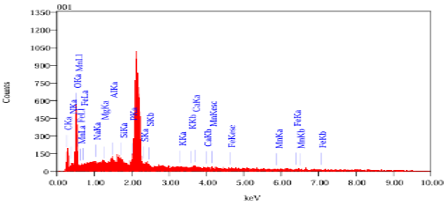
Acacia bark powder (Acacia crassicarpa) is a biomass containing cellulose compounds as active sites for adsorption. This study aims to optimise the adsorption parameters of Rhodamine B by acacia bark powder. The method used in this study is batch adsorption. The adsorbent is prepared in powder form with a particle size of 100–200 mesh. SEM-EDS characterisation results showed a porous surface morphology of the adsorbent, dominated by carbon (C) and oxygen (O) elements. BET analysis revealed a specific surface area of 0.460 m²/g, pore volume of 4.361×10⁻³ cc/g, and pore diameter of 379.008 Å. FTIR results indicated the presence of functional groups N-H, -OH, C-H, C=O, C=C, and C-O. Optimal adsorption conditions were obtained at an adsorbent dose of 0.5 g, pH 2, contact time of 50 minutes, stirring speed of 200 rpm, adsorbate concentration of 40 mg/L, and temperature of 50°C, with an adsorption efficiency of 99.04% and adsorption capacity of 3.9326 mg/g. The results of this study indicate that Acacia crassicarpa bark powder has good performance in adsorbing Rhodamine B dye.
Downloads
Article Details

This work is licensed under a Creative Commons Attribution 4.0 International License.
Copyright and Licensing
For all articles published in Fullerene Journal of Chemistry, Authors retain some copyright and grant the journal right of first publication with the work simultaneously licensed under a Creative Commons Attribution 4.0 International (CC BY 4.0) that allows others to share the work with an acknowledgment of the work's authorship and initial publication in this journal. Authors are able to enter into separate, additional contractual arrangements for the non-exclusive distribution of the journal's published version of the work (e.g., post it to an institutional repository or publish it in a book), with an acknowledgment of its initial publication in this journal. Authors are permitted and encouraged to post their work online (e.g., in institutional repositories or on their website) prior to and during the submission process, as it can lead to productive exchanges, as well as earlier and greater citation of published work. In addition, the article may be reused and quoted provided that the original published version is cited. These conditions allow for maximum use and exposure of the work while ensuring the authors receive proper credit.
Authors are free to:
- Share - copy and redistribute the material in any medium or format
- Adapt - remix, transform, and build upon the material for any purpose, even commercially.
Under the following terms:
- Attribution - You must give appropriate credit, provide a link to the license, and indicate if changes were made. You may do so in any reasonable manner, but not in any way that suggests the licensor endorses you or your use.
- No additional restrictions - You may not apply legal terms or technological measures that legally restrict others from doing anything the license permits.
Notices: You do not have to comply with the license for elements of the material in the public domain or where your use is permitted by an applicable exception or limitation. No warranties are given. The license may not give you all of the permissions necessary for your intended use. For example, other rights such as publicity, privacy, or moral rights may limit how you use the material.